
💡 How I Discovered “Amal’s First Switch Equation” – A New Way to Think About FizzBuzz with Switch-Case
What if you had to solve FizzBuzz using only
switch-case— noif, no ternary operators?
Most of us have solved FizzBuzz using if-else. It's one of the most common programming exercises taught to beginners, and often used in interviews to test logical thinking.
Yesterday, during a coding session, our mentor gave us that exact challenge. It sounded simple but turned into a deep exploration that led me to something surprising — something I now call:
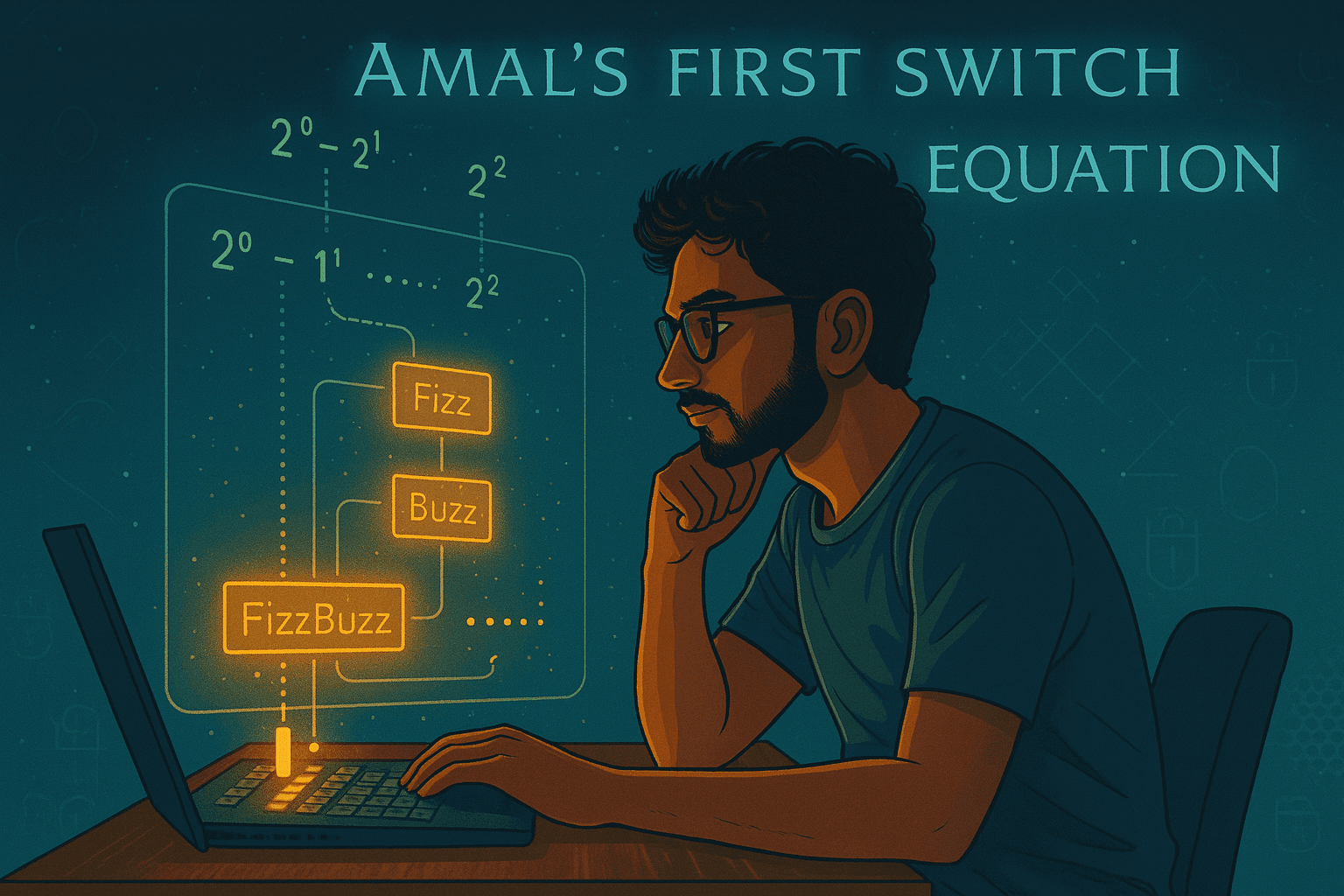
Amal’s First Switch Equation
It’s a simple way to map multiple true/false conditions into a single key — using powers of 2, using binary logic used in bit-masking — so we can use switch-case elegantly without branching.
Key = (result % x1== 0)*2⁰ + (result % x2 == x2)*2¹+………+(result % xn== 0)*2^n-1

Explanation
If there are 'n' numbers, then first of all, we can find the key by taking powers of 2 up to 2^n-1 in the respective order, starting from 2^0.
Then, when all '(𝘳𝘦𝘴𝘶𝘭𝘵 % x1==0) to (𝘳𝘦𝘴𝘶𝘭𝘵 % x𝘯==0)' conditions gets true, then the total sum would be the number of cases.
Example
Consider numbers 3 and 5.
n=2
Key = (result%3==0) x 2^0 + (result%5==0) x 2^2-1
\= (result%3==0) x 1 + (result%5==0) x 2
Now, to find the number of cases,
Max true value will be 1 x 1 + 1 x 2 = 1 + 2 = 3
So there will be 3 cases* [case 1: Fizz, case 2: Buzz, case 3: FizzBuzz]
* this is except 'default' case.
Why This Is Useful
Avoids nested
if-elsechainsMakes logic scalable — easily add more conditions
Gives a clean
switch-casestructureIntroduces beginners to the power of bit-masking
Conclusion
I did not come across this key in a book or tutorial. It was born from pure experimentation and the limitations set by my instructor: "Don’t use if-else. Try using only switch." That constraint led me to think differently. I spent time rewriting the logic, breaking combinations, and eventually the switch-case became viable again with one powerful key.
I call it Amal’s First Switch Equation not out of ego, but as a reminder that discoveries often come from trying new paths. Anyone can find something unique when they push boundaries.